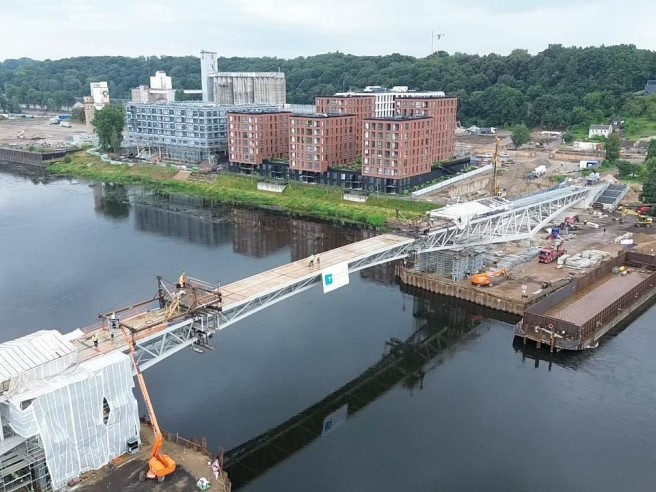
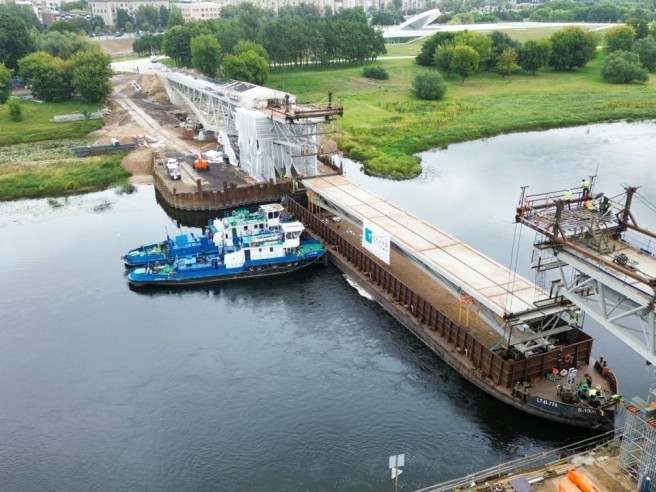
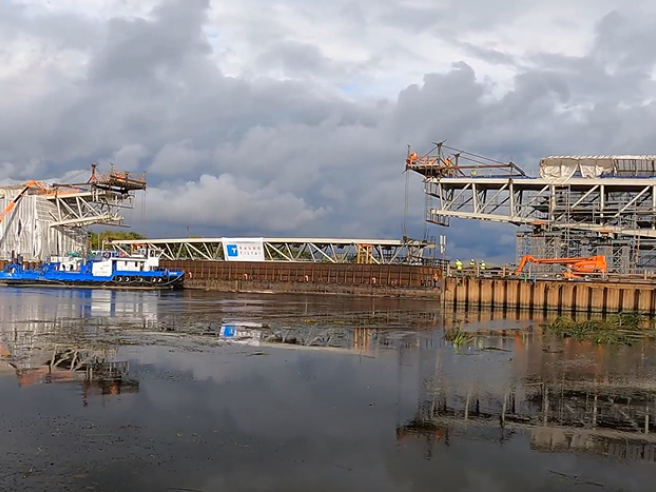
One of the most complex and technically demanding phases of the construction of the bridge connecting Ž. Freda and Nemunas Island is currently underway. The central steel deck structure, which will connect the supports of the future pedestrian and bicycle bridge over the Nemunas River, is being successfully installed in its design position.
The steel structure, which is 53 meters long, 6.5 meters wide, and weighs as much as 133 metric tons, was initially assembled by construction workers on-site from separate components. The steel structure, which was exceptionally large and heavy, was then transferred to a barge, which transported it to the site where the deck was to be hoisted into place.
The deck installation work took three days. On the first day, the barge carrying the steel structure was towed to the middle of the Nemunas River, where the hoisting began using special lifting mechanisms manufactured specifically for this project—standard construction cranes were not used in this operation. On the second day, the hoisting work continued until the structure reached its exact design position, after which the barge was moved out of the work area.
The biggest challenge for the construction team came right at the start of the process—due to the strong current of the Nemunas River, it was extremely difficult to position the barge precisely across the river. The team successfully tackled this task, and the rainy weather did not disrupt the scheduled work.
A team of 20 specialists took part in this engineering challenge: engineers, surveyors, construction managers, and welding and installation specialists. Foreign experts in this field, with experience in performing complex structural lifting operations, were also brought in to assist with the exceptionally complex installation process.
Jolanta Varkalienė, project manager at the company carrying out the work, says that operations of this nature are rarely performed in Lithuania: “This was not a standard lifting of a floor slab by cranes from the shore—due to the structure’s weight and the river’s width, we had to develop custom lifting mechanisms for this project and meticulously plan the lifting sequence. When the river’s current shifted the barge’s position several times, the team had to make quick decisions without halting the process. The fact that we installed the 133-metric-ton structure with precision in just three days demonstrates the excellent preparedness of all the specialists involved in the operation.”
With the installation of the deck successfully completed, construction work continues—welding of the deck, installation of handrails, laying of protective surfacing, and installation of quay and bridge approach structures are scheduled for the near future.
About the structure
The future bridge will connect Nemuno Island with Žemąja Freda and the “Nemunaičiai” neighborhood. Once the project is completed, residents will have easy access to the city center, “Mokslo Sala,” the park, the “Žalgirio” Arena, and the swimming pool. The 258-meter-long structure will be designed for pedestrians and cyclists; in exceptional cases, emergency services will be able to use it.